
Marked failure
If you thought the political ones were bad, lord help me I'm dabbling in economics.

Canada’s grocery sector is notorious. As a cartel it’s not quite on the scale of Mexico, but only because Mexico’s cartels are more numerous, generating some semblance of competition.
In 2024, compensation was offered to all Canadian citizens who had bought bread between (at least) 2005 and 2015. During this time a group of competing bread producers, retailers and supermarket chains conspired to fix the price of a whole range of products via what became known as the 7/10 convention. Under this scam, the conspirators agreed to increase wholesale prices by $0.07 and retail by $0.10 twice a year. It was estimated that the scheme inflated the cost of bread by 96% during a period when CPI for all food items rose by 45%.
After the resulting legal case, affected Canadians were entitled to apply for a share of the $500,000,000 in compensation, it was estimated that they would receive between $50 and $100 each.
We arrived just as this scandal was reaching its conclusion. Public antipathy toward companies like Loblaws was palpable and vocally expressed even beyond the normal rabble who can be expected to complain about big corporations.
Then it seemed to fade away. Trump started threatening annexation, and after he was elected a wave of patriotism inspired consumers to start consciously avoiding US products in favour of Canadian ones. Big grocery stores capitalized on the change in vibe. Suddenly Canadian flags were everywhere. Loblaws branded itself “proudly Canadian” and stickers appeared on shopping isles and only grocery stores to demarcate “Canadian produce”, for the discerning and patriotic shopper.
Except that they didn’t. Before the year was halfway out, the Canadian Food Inspection Agency had started handing out fines to Loblaws and Sobeys after their stores were found to have mislabeled products as Canadian.
Underneath the scandals, like a low-grade hum of discontent, is the knowledge that groceries in Canada are just more expensive. There’s fewer big chains and none of the discount stores that drive prices down in Europe.
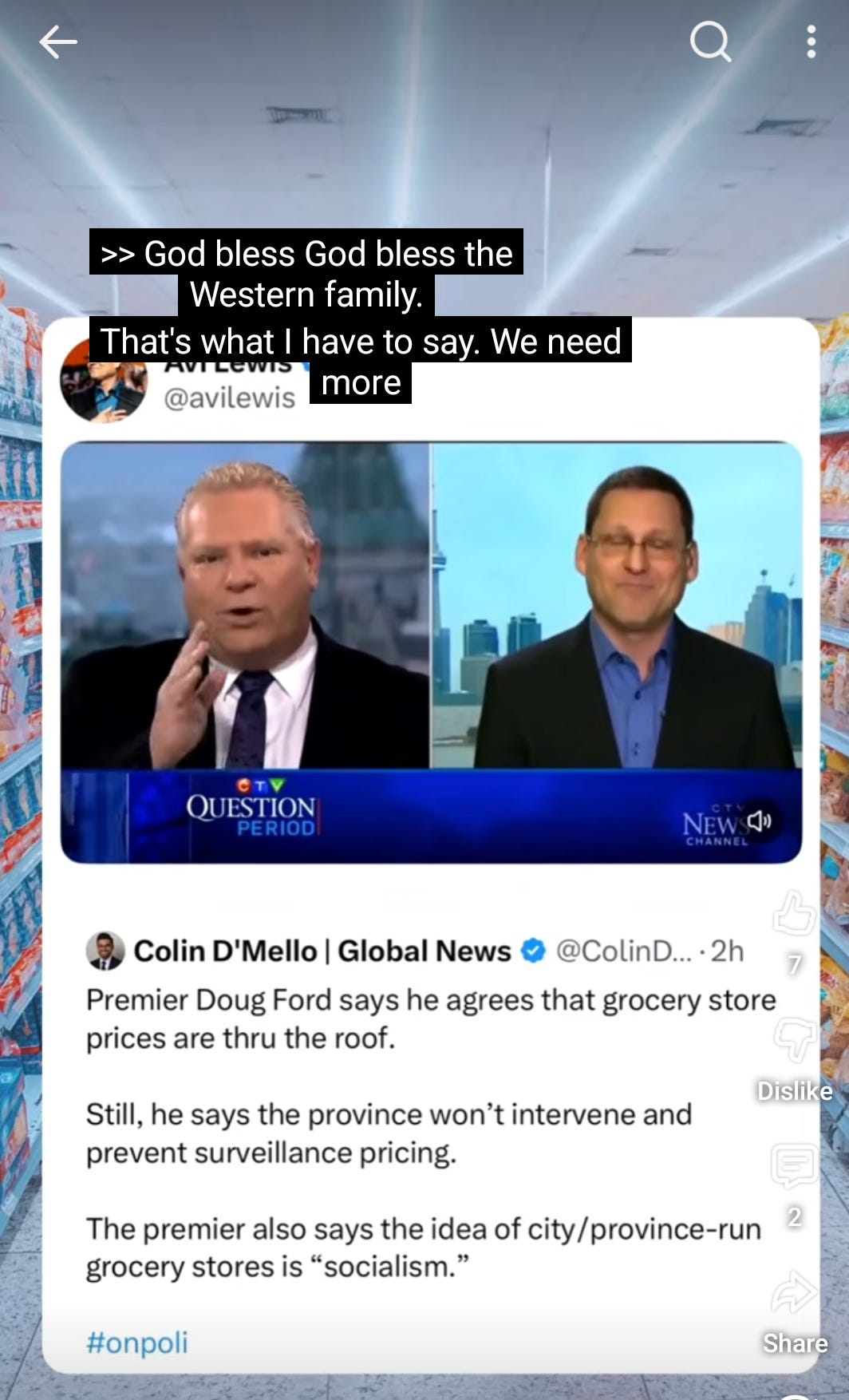
Last week, Ontario Premier Doug Ford dismissed the suggestion that he ban surveillance pricing of online grocery products. As the name suggests, surveillance pricing is the practice of collecting data on individuals' shopping habits, and dynamically increasing prices on the items they purchase most often. Ford’s logic was infallible: he didn’t need to intervene because the market would take care of this…The market? The market? What, the domestic market? The same one that gave us the 7/10 convention? The one where stores were mislabeling their food to fool consumers they were Canadian? The one in which Sobeys has just been caught overcharging for underweight meat, again? That market? Surely you jest? Ford, who once declared “God bless (Loblaws owners) the Weston family” promises that if the big grocers get up to any funny business, then he will “rip them a new one”. Sure, and I have a proverbial bridge to flog.
Pierre Poilievre has actually gone big on the cost of groceries for several years. However, his solution is to take the government out of the equation and let the same companies found guilty of massive fraud and malfeasance have an even freer hand, following the same logic that led medieval doctors to prescribe more blood letting.
One reason why Canada has the highest food inflation in the G7 is that once you look under the surface it’s monopolies all the way down: four companies hold 72% of the grocery market, two companies control 80% of bread production, two producers slaughter 95% of the cattle. And they behave as you would expect: fixing prices, paying kickbacks to each other for stocking their produce, and strong-arming shopping centres and malls to stop them letting out space to rivals within walking distance. New NDP leader, Avi Lewis has proposed a public option for groceries, as has Toronto mayor, Olivia Chow; the idea being that the state could offer a cheaper option that might drive down prices all round. Doug Ford was quick to dismiss this idea as “The craziest idea (he’d) ever heard” and “socialism does not work”. There are three problems with this:
1) Its painfully obvious the current system doesn’t work and
2) This would in fact increase the level of competition in the system
3) It’s hard to argue that state-run stores are “crazy’” in Ontario, the province with the publicly owned booze-shops.
The whole reason you avoid monopolies is precisely because once they’re established they conspire to subvert the market and further entrench themselves. If the market was going to do something about this, the market would have already done something about it already, and the same could be said about the premier.
Edited by Jasper Jackson.