
Union Do's
And union don'ts.

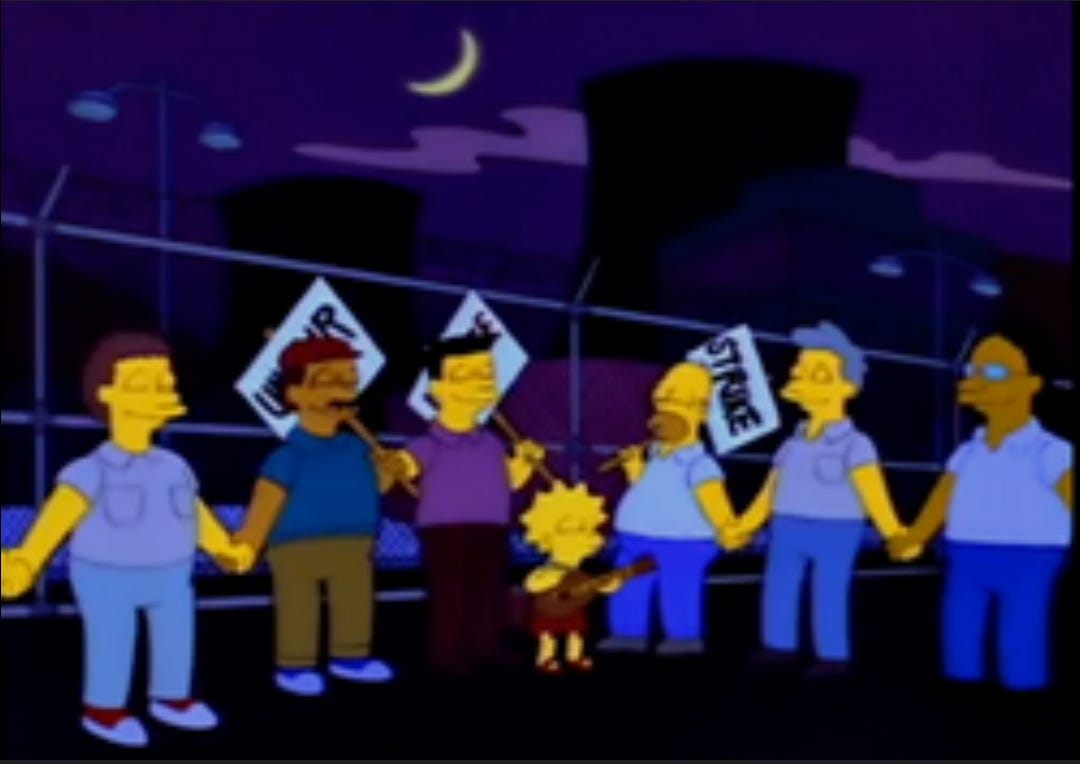
A lot of people assume that the job of the union is to make trouble for management. They turn up, tell everyone the boss is a scumbag and if at all possible get them out on strike.
Negotiation in this model, is an inconvenient farce you must play out before getting to the real business of whipping out the placards and yelling down the megaphone. Then the employer concedes to all your demands. They are humbled by the sheer audacity and verve of your slogans and chants.
It stands to reason, therefore, that any offer shy of complete capitulation is a failure.
People are often surprised to see unions leave the table with partial victories. Incremental, but significant gains. Major concessions watered down, delayed, or otherwise ameliorated, but not totally abandoned. Unions will often present these as wins, tell their members this is a good deal and they should accept it.
It’s not hard to understand why some on the left are dismissive of organized trade unionism. Union officials, they say, are essentially another arm of capital. They serve to discipline workers' demands, keep them moderate, and then tell the membership to be grateful when they don't even get that much.
You'll notice that the image of the union I've given you in the last paragraph is radically different from that in the first. But I think they both stem from a similarly mistaken view of the dynamic in a unionized workplace.
Unions operate in a fundamentally unequal power dynamic. The employer owns the workplace. They also own any equipment or machinery or software required to conduct the work.The employer has control over the money which pays for all these, and crucially, which is paid out in wages/salary and enables the workers to access all the essentials of life.
Moreover, there are legal structures that act as obstacles to union power and support to that of the employer. In Canada, unions face steep penalties if they take action while a contract is in force. Issues that crop up during the term of a contract have to be resolved through an often protracted grievance procedure, and the scope for industrial action is extremely limited.
In the UK, unions can take industrial action whenever they like, providing they can clear a series of ballot hurdles designed specifically to prevent it. Unions have to secure consent of 40% of the membership, on turnout of over 50% and ballots can only be submitted in paper format. None of the recent Conservative party leaders and very few recent Prime Ministers would have secured their position had they been held to the conditions imposed on unions. These ballots have to be rerun every six months or they expire and industrial action becomes illegal.*
As well as structural supports / obstacles there are cultural or attitudinal ones. The union is on the hook for serious financial penalties if their members take unofficial or illegal action. So union officials and reps are often put in the position of doing management's job for them; trying to impose discipline and incurring resentment and distrust from their membership. The fact that (by necessity) the union bargaining committee spends hours holed up with the employer, in rooms from which the wider membership are normally absent, only exacerbates this.
Then a tentative deal is hammered out between union and employer, and the union has to perform a strange pirouette. Previously their communications to the members emphasised all the things they lacked, what the boss was failing to provide. The moment they have a deal in principle it is by definition acceptable to the employer. But it still has to be ratified by the membership and it is the job of the union to go back and sell it. They have to tell their members, “This is the best deal we could get. It may not have everything you told us you wanted way back when, when we started this process. But it's a substantial improvement on your position before”. Or if negotiations have been really hard “This is the best we could get, it might mean we make concessions but those concessions started out a lot worse”. Implicitly or explicitly the union is saying to the membership, if you want better than this, you might have to strike for it.
Of course, there are times when the union is saved from performing this pirouette, because there’s no deal to be done. There are times when going on strike is necessary, and it can be hugely powerful. Strikes can be motivating, they can demonstrate to the members that they have power and can use it. But, for all their reputation, the union normally doesn’t want to strike unless they have to. Strikes are expensive, they are draining for organizers and members. They involve a complicated and exhausting process of maintaining the morale and motivation of the members and securing support from the public. Moreover, they are fraught with legal risk, if members overstep the boundaries they bring stiff penalties down on the union and themselves. Finally, backing down without significant concessions is a serious blow to the union’s standing with members and management.
Plus in Canada, there’s always the risk that provincial, territorial or federal governments will decide to invoke the NotWithStanding clause and order you back to work anyway, because Canada’s constitution is WILD.
Criticism of unions often misses this power disparity. Critics assume unions start from a position of equality with the employer and then they assume union action is an attempt to bully the boss or an attempt to dupe the workers. But union action is a pragmatic attempt to make gains and limit losses given the very real handicaps in place.
This might seem like a very dour view of collective action. But only if you're comparing it to a world where employers deliver fair and equitable treatment of their own accord. Or one where workers have free rein to establish their terms and conditions. Both of which sound great but neither are on offer. I think the alternative is that workers get far less equitable treatment and live less dignified lives. Which would be reason enough to support the union. But I also think the way we work is a hugely important component of how we live. Organising people on that basis is vital for creating a politics and a society where ties of solidarity support collective endeavor. And collective endeavor is the best chance we have to address the myriad threats and challenges we face. Telling someone they need to show solidarity is all very well, but giving them practical examples of it in action is far more convincing.
Some people argue that it's better to reject that system and try to push for a radical restructuring of society that would remove those handicaps. Other people think that workers should focus on advancing through their own efforts and not rely on institutions to artificially level the playing field. Both of those are coherent positions, but neither will get you very far in a negotiation.
*These restrictions are the product of the 2016 Trade Union Act and are slated for repeal when the Employment Rights Bill passes. After which point, the UK’s trade union legislation will return to the state that Tony Blair used to boast was “The most restrictive in the Western World”.
Edited by Jasper Jackson.